
The Eyewear Maker — A Craft Built on Precision and Time
Not a profession. A way of seeing.
There are crafts that produce objects. And there are crafts that shape the way people move through the world. Eyewear making is one of the latter — and when it is done well, it produces something closer to luxury glasses than to a functional tool.
A frame sits at the intersection of the face and everything else. It is the first thing people see, and the last thing the wearer thinks about — or should think about, if the frame is right. That tension between visibility and invisibility is what makes the craft demanding. And what makes it worthwhile.
The material comes first
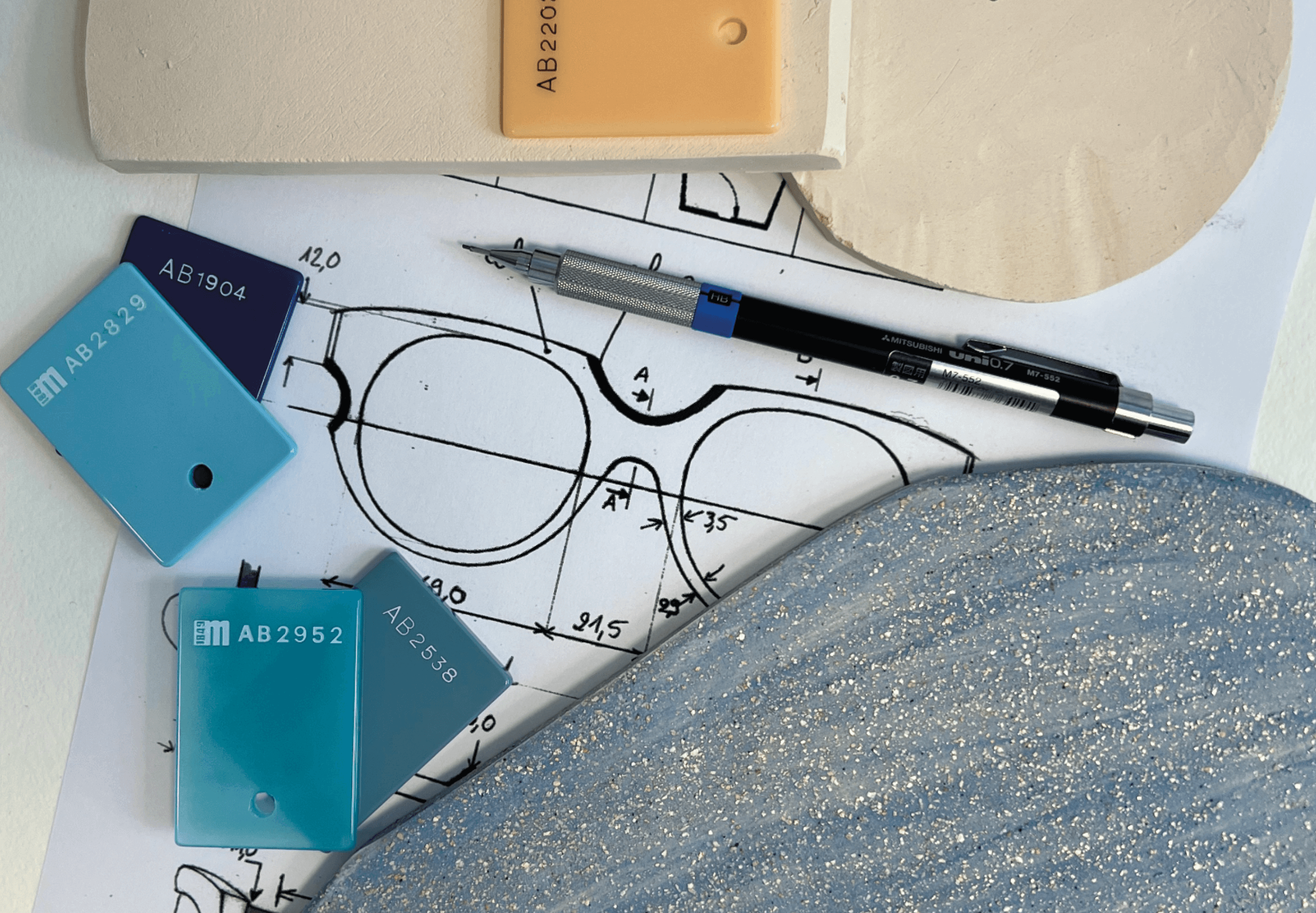
Before any frame exists, there is a material. At TARIAN, the process begins not with a sketch but with an acetate slab — chosen for its colour, its depth, its weight in the hand. Almost half of the acetates used by TARIAN are developed exclusively for the brand, in collaboration with Mazzucchelli, one of Italy's most respected producers of the material. This is one of the defining characteristics of serious French eyewear: the refusal to use generic materials from a shared catalogue.
Colour that runs through the material — not applied to its surface — behaves differently in light, ages differently over time, feels different against the skin. The material determines what the frame can be before a single cut is made. This is what distinguishes premium optical frames from commodity products.
The drawing
Every TARIAN frame begins as a drawing, made by hand by Jérémy Miklitarian in his Paris eyewear atelier. The drawing determines the shape, the volume, the proportions. It is the moment where a feeling becomes a form.
The drawing does not attempt to replicate what already exists. It starts from what a face needs — lightness, balance, a presence that is felt without being announced. This is the foundation of independent eyewear design: starting from function, arriving at elegance.
The making
Between the drawing and the finished frame, six to twelve months pass. The acetate must be cut, shaped, polished and assembled by hand. Each stage requires specific expertise. None of it can be rushed — the material demands time to cure, to settle, to reveal its final character. This is what handmade glasses actually involve: not simply manual assembly, but a process calibrated to the properties of the material itself.
TARIAN frames are made in the Veneto region of Italy, by artisans who have worked acetate for generations. The AXIS flex hinge — screwless, weightless, designed to disappear on the face — is one of the technical signatures of the brand. It is not a novelty. It is the result of a precise understanding of what comfort means when a frame is worn every day, all day. This attention to comfort is part of what defines luxury eyewear — not just the appearance, but the wearing experience.
The object
Each TARIAN model is produced in a controlled run of 500 numbered pieces. This is not a marketing decision. It is the direct consequence of how the frames are made: by hand, from materials that take time, by artisans whose work cannot be scaled without losing what makes it worth doing. It is what a commitment to designer glasses actually looks like in practice.
500 pieces per model. Each one numbered. Each one made to last.
The eyewear maker does not make accessories. The eyewear maker makes objects that become part of a person's face — and, if the work is done well, part of how that person sees themselves.